Check Opposum and Mole geting down with their celebration dances. Can't get enough of this:
Thursday, November 26, 2009

Fantastic. Absolutely Fantastic
First of all, an extra special thank you to Jah for making Fantastic Mr. Fox even more Fantastic!
Second, Fantastic Mr. Fox is my favorite movie of the year so far, no question. Wes Anderson's quirky creativity blew my mind away and I'm pretty sure I will watch this movie again soon enough to catch things I missed the first time
Third, this:

("Sometimes I feel like you don't understand what I'm saying...")
Second, Fantastic Mr. Fox is my favorite movie of the year so far, no question. Wes Anderson's quirky creativity blew my mind away and I'm pretty sure I will watch this movie again soon enough to catch things I missed the first time
Third, this:

("Sometimes I feel like you don't understand what I'm saying...")
Sunday, November 22, 2009

Wednesday, November 18, 2009
2009 (not 2012) part III


(Two friends: Big Bear [left] and Big Bird [right])
A true personal story about Jah (real names have been altered to protect the innocent)
Big Bird:
Imagine how it would be like if the world ended in the same way as in 2012? We would be so scared man
Big Bear:
No man, because as we fall toward the center of the earth Jah would appear and save us
Big Bird:
Jah???
Big Bear:
Jah man! He's like a god. They always mention him in Reggae songs. He would appear out of the earth and talk to us: "You have been so loyal to me. I will take you to paradise where each of you will have whatever you want, including 12 virgins."
Big Bird:
12 virgins eh? cool...
Big Bear:
Jah, 12 virgins. You can have whatever you want. I would have black, Asian, blonde, a Joan. But I would ask Jah: "Jah, could I ask you for a favour? Could I have 13 virgins? Only because she makes good food, could I have W***y from M*******a? For when I want to 'thank' her for the good food"
Little Bear:
Joanie. I like redheads hehehe

(Above: A third friend, Little Bear)

(Another friend, and honorary Banana brother, Mr. Shrek aka Shreky [right] with one of his Korean female friends. Don't eat her Shreky!)

2009 (not 2012) part II
PRECAUTIONARY STATEMENT: This blog does not promote the use of cannabis in any way, shape or form. Cannabis is an illegal substance in many jurisdictions, considered harmful, and frequent use may lead to addiction and dependence. Please confirm with local law enforcement and your health professional before consuming Cannabis. Minors, please ask your parents before attempting to consume cannabis.

(A album cover for the one and only Mr. Bob Marley, showing him spiritually consuming what seems to be a spliff)
Courtesy of Wikipedia (more info after jump):
. . .

(A album cover for the one and only Mr. Bob Marley, showing him spiritually consuming what seems to be a spliff)
Courtesy of Wikipedia (more info after jump):
"Religious and spiritual use of cannabis
. . .
Cannabis has an ancient history of ritual usage as an aid to trance and has been traditionally used in a religious context throughout the Old World. Herodotus wrote about early ceremonial practices by the Scythians, which are thought to have occurred from the 5th to 2nd century BCE. Itinerant sadhus have used it in India for centuries, and in modern times it has been embraced by the Rastafari movement. Anthropologist Sula Benet claimed historical evidence and etymological comparison show that the Holy anointing oil used by the Hebrews contained cannabis extracts, "kaneh bosm" (קְנֵה-בֹשֶׂם), and that it is also listed as an incense tree in the original Hebrew and Aramaic texts of the Old Testament. Early Christians used cannabis oil for medicinal purposes and as part of the baptismal process to confirm the forgiveness of sins and "right of passage" into the Kingdom of Heaven.[citation needed] The Unction, Seal, laying on of hands, the Counselor, and the Holy Spirit are all often synonymous of the Holy anointing oil.[1] Early Gnostic texts indicate that the Chrism is essential to becoming a "Christian".[2][3] Some Muslims of the Sufi order have used cannabis as a tool for spiritual exploration.
. . .Rastafari use
Members of the Rastafari movement use cannabis as a part of their worshiping of God, Bible study and Meditation. The movement was founded in Jamaica in the 1930s and while it is not known when Rastafarians first made cannabis into something sacred it is clear that by the late 1940s Rastafari was associated with cannabis smoking at the Pinnacle community of Leonard Howell. Rastafari see cannabis as a sacramental and deeply beneficial plant that is the Tree of Life mentioned in the Bible. Bob Marley, amongst many others, said, "the herb ganja is the healing of the nations." The use of cannabis, and particularly of large pipes called chalices, is an integral part of what Rastafari call "reasoning sessions" where members join together to discuss life according to the Rasta perspective. They see cannabis as having the capacity to allow the user to penetrate the truth of how things are much more clearly, as if the wool had been pulled from one's eyes. Thus the Rastafari come together to smoke cannabis in order to discuss the truth with each other, reasoning it all out little by little through many sessions. They see the use of this plant as bringing them closer to nature. In these ways Rastafari believe that cannabis brings the user closer to Jah, Haile Selassie I, and pipes of cannabis are always dedicated to His Imperial Majesty before being smoked [my emphasis]. While it is not necessary to use cannabis to be a Rastafari, some feel that they must use it regularly as a part of their faith. "The herb is the key to new understanding of the self, the universe, and God [my emphasis]. It is the vehicle to cosmic consciousness" according to Rastafari philosophy,[29] and is believed to burn the corruption out of the human heart. Rubbing the ashes from smoked cannabis is also considered a healthy practice[30]."
2009 (not 2012)
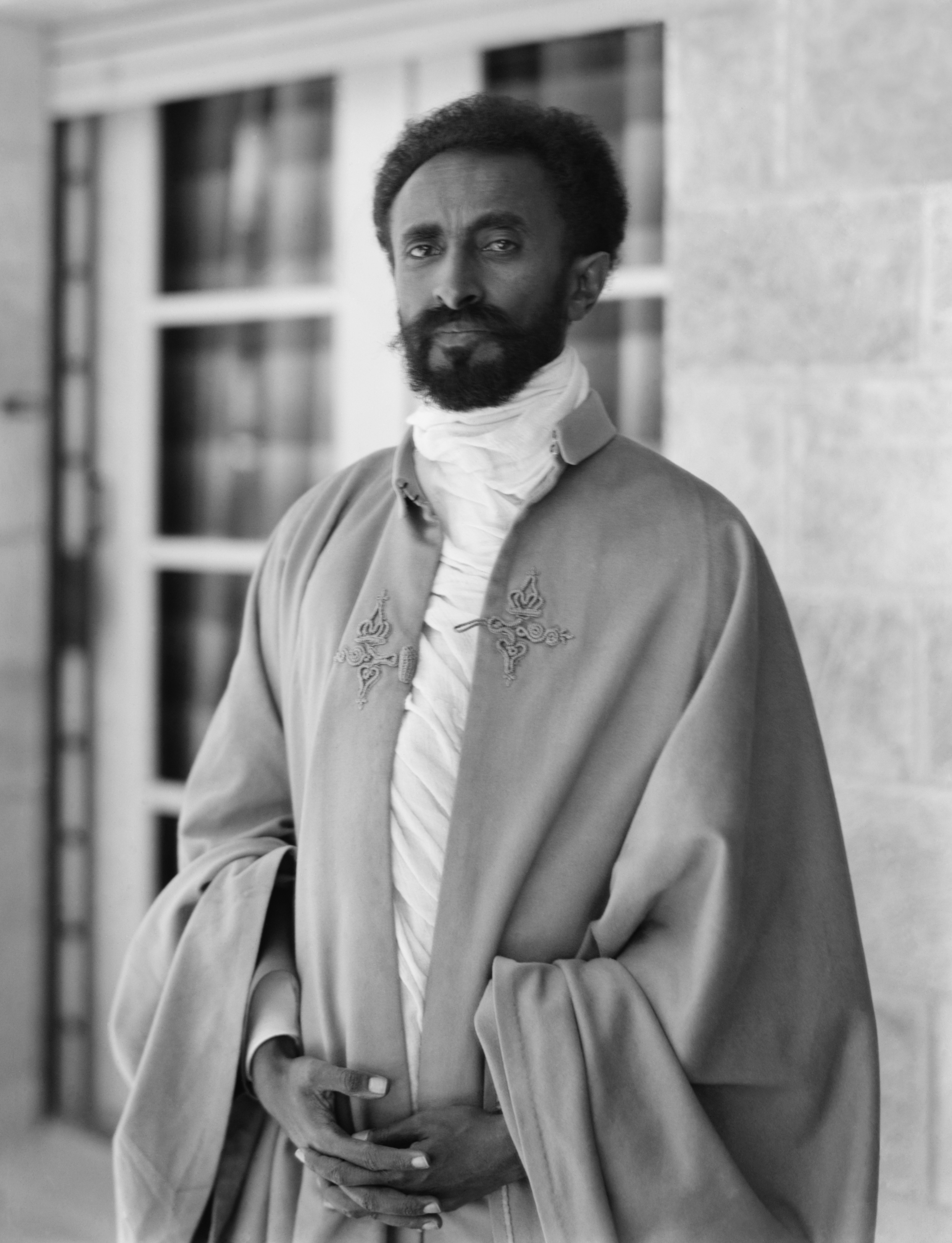
(Haile Selassie I, the incarnation of Jah)

(The flag of Ethiopia with the Lion symbol representing Jah)
Courtesy of Wikipedia (more info after jump):
"The Rastafari movement is a monotheistic, Abrahamic, new religious movement[1] that contends that Haile Selassie I, the former, and final, Emperor of Ethiopia, is the incarnation of God, called Jah[2] or Jah Rastafari.
The movement encompasses themes such as the spiritual use of cannabis, colloquially known as marijuana[3][4], and the rejection of western society (called Babylon, in reference more to the metaphoric Babylon of Christianity than to the historical Mesopotamian city-state). It is also based on various Afrocentric social and political aspirations,[3][5] such as the sociopolitical views and teachings of Jamaican publicist, organizer, and black nationalist Marcus Garvey (also often regarded as a prophet). Haile Selassie was in favor of a Westernized Ethiopia, introducing the first hospital and airport to his people. The Rastafari movement predominantly emerged in Jamaica in the 20th century, and it proclaims Africa (also "Zion") as the original place where the body of the first man was found.
The name Rastafari is a portmanteau of "Ras" (literally "Head," an Ethiopian title equivalent to Duke and which was the pre-regnal title of Haile Selassie), and the first name of Selassie's pre-regnal given name, Tafari Makonnen. The movement is commonly referred to as "Rastafarianism", but this term is considered derogatory and offensive by some Rastas.[6]
. . .God
Rastafari are monotheists, worshipping a singular God whom they call Jah. Rastas see Jah as being in the form of the Holy Trinity, that is, God being the God the Father, God the Son, and the Holy Spirit. Rastas say that Jah, in the form of the Holy Spirit (incarnate), lives within the human, and for this reason they often refer to themselves as "I and I". Furthermore, "I and I" is used instead of "We", and is used in this way to emphasise the equality between all people, in the recognition that the Holy Spirit within us all makes us essentially one and the same.
Some Rastas accept the Christian doctrine that God incarnated onto the Earth in the form of Jesus Christ, to give his teachings to humanity. However, they often feel his teachings were corrupted by Babylon. Many Rastas[who?], in accordance with their assertion that "word, sound is power", also object specifically to the English pronunciation of his name (/dʒi:zəs/) as impure, preferring instead to use the forms in Hebrew (Yeshu) or Amharic ('Iyesus).
. . .Zion vs. Babylon
Rastas assert that Zion (i.e., Africa, especially Ethiopia) is a land that Jah promised to them. To achieve this, they reject modern western society, calling it "Babylon", which they see as entirely corrupt.[3][5][9] "Babylon" is considered to have been in rebellion against "Earth's Rightful Ruler" (Jah) ever since the days of the Biblical king Nimrod.
Some Rastas claim themselves to represent the real Children of Israel or children of god, (this point of view may have been spawned from the belief by some Jewish scholars that Ethiopia was populated at some stage by one of the "lost" tribes of Israel; modern credence is given to this view with the acknowledgement of the Beta Israel by the Israeli government. Another historical viewpoint which seeks to validate this link between Ethiopia, Israel and the Rastafari belief system can be found under the Lion of Judah and their goal is to repatriate to Africa, or to Zion. (Rasta reggae is peppered with references to Zion; among the best-known examples are the Bob Marley songs '"Zion Train" and "Iron Lion Zion".)
Paradise
Many Rastafari are physical immortalists who maintain that the chosen few will continue to live forever in their current bodies. This is commonly called "Everliving" life, particularly in the context of "Life Everliving with Jah" as king and Amharic the official language. This replaces the term "everlasting", as "last" in "everlasting" implies an end (as in the term "at last"), whereas Rastas say their life will never have an end.
. . .
Diet
Main article: Ital
Many Rastas eat limited types of meat in accordance with the dietary Laws of the Old Testament; they do not eat shellfish or pork. Others abstain from all meat and flesh whatsoever, asserting that to touch meat is to touch death, and is therefore a violation of the Nazirite vow. (A few make a special exception allowing fish, while abstaining from all other forms of flesh.) However, the prohibition against meat only applies to those who are currently fulfilling a Nazirite vow ("Dreadlocks Priesthood"), for the duration of the vow. Many Rastafari maintain a vegan or vegetarian diet all of the time. Food approved for Rastfari is called ital. The purpose of fasting (abstaining from meat and dairy) is to cleanse the body in accordance to serving in the presence of the "Ark of the Covenent".
Usage of alcohol is also generally deemed unhealthy to the Rastafari way of life, partly because it is seen as a tool of Babylon to confuse people, and partly because placing something that is pickled and fermented within oneself is felt to be much like turning the body (the Temple) into a "cemetery".
In consequence, a rich alternative cuisine has developed in association with Rastafari tenets, eschewing most synthetic additives, and preferring more natural vegetables and fruits such as coconut and mango. This cuisine can be found throughout the Caribbean and in some restaurants throughout the western world.
Some of the Houses (or "Mansions" as they have come to be known) of the Rastafari culture, such as the Twelve Tribes of Israel, do not specify diet beyond that which, to quote Christ in the New Testament, "Is not what goes into a man's mouth that defile him, but what come out of it". Wine is seen as a "mocker" and strong drink is "raging"; however, simple consumption of beer or the very common "Roots Wine" are not systematically a part of Rastafari culture this way or that. Separating from Jamaican culture, different interpretations on the role of food and drink within the religion remains up for debate. At official state banquets Haile Selassie would encourage guests to "eat and drink in your own way".
Ganja

See also: Spiritual use of cannabis
For Rastas, smoking cannabis, usually known as "herb", "weed", "sinsemilla" (spanish for "without seeds") or "ganja" (from the Sanskrit word, "Ganjika", created by the Hindus of India), is a spiritual act, often accompanied by Bible study; they consider it a sacrament that cleans the body and mind, heals the soul, exalts the consciousness, facilitates peacefulness, brings pleasure, and brings them closer to Jah. The burning of the herb is often said to be essential "for it will sting in the hearts of those that promote and perform evil and wrongs." By the 8th century, cannabis had been introduced by Arab traders to Central and Southern Africa, where it is known as "dagga"[12] and many Rastas say it is a part of their African culture that they are reclaiming.[13] It is sometimes also referred to as "the healing of the nation", a phraseology adapted from Revelation 22:2.[14]
The migration of many thousands of Hindus from India to the Caribbean in the 20th century may have brought this culture to Jamaica. Many academics point to Indo-Caribbean origins for the ganjah sacrament resulting from the importation of Indian migrant workers in a post-abolition Jamaican landscape. "Large scale use of ganjah in Jamaica... dated from the importation of indentured Indians..."(Campbell 110). Dreadlocked mystics, often ascetic, known as sadhus, have smoked cannabis in India for centuries.[15]
According to many Rastas, the illegality of cannabis in many nations is evidence that persecution of Rastafari is a reality. They are not surprised that it is illegal, seeing it as a powerful substance that opens people's minds to the truth — something the Babylon system, they reason, clearly does not want.[16] They contrast their herb to alcohol and other drugs, which they feel destroy the mind.[17]
They hold that the smoking of cannabis enjoys Biblical sanction, and is an aid to meditation and religious observance. Among Biblical verses Rastas quote as justifying the use of cannabis:
- Genesis 1:11 "And God said, Let the earth bring forth grass, the herb yielding seed, and the fruit tree yielding fruit after his kind, whose seed is in itself, upon the earth: and it was so."
- Genesis 1:29 "And God said, Behold, I have given you every herb-bearing seed, which is upon the face of all the earth, and every tree, in the which is the fruit of a tree yielding seed; to you it shall be for meat."
- Genesis 3:18 "... thou shalt eat the herb of the field."
- Proverbs 15:17 "Better is a dinner of herbs where love is, than a stalled ox and hatred therewith."[2]
- Psalms 104:14 "He causeth the grass to grow for the cattle, and herb for the service of man."
- Revalation 22:2 " the river of life proceeded to flow from the throne of God, and on either side of the bank there was the tree of life, and the leaf from that tree is for the healing of the nations"
According to some Rastafari[18] and other scholars, the etymology of the word "cannabis" and similar terms in all the languages of the Near East may be traced to the Hebrew "qaneh bosm" קנה-בשם, which is one of the herbs God commanded Moses to include in his preparation of sacred anointing perfume in Exodus 30:23; the Hebrew term also appears in Isaiah 43:24; Jeremiah 6:20; Ezekiel 27:19; and Song of Songs 4:14. Deuterocanonical and canonical references to the patriarchs Adam, Noah, Abraham and Moses "burning incense before the Lord" are also applied, and many Rastas today refer to cannabis by the term "ishence" — a slightly changed form of the English word "incense". It is also said that cannabis was the first plant to grow on King Solomon's grave.
In 1998, then-Attorney General of the United States Janet Reno, gave a legal opinion that Rastafari do not have the religious right to smoke ganjah in violation of the United States' drug laws. The position is the same in the United Kingdom, where, in the Court of Appeal case of R. v. Taylor [2002] 1 Cr. App. R. 37, it was held that the UK's prohibition on cannabis use did not contravene the right to freedom of religion conferred under the Convention for the Protection of Human Rights and Fundamental Freedoms.
On January 2, 1991, at an international airport in his homeland of Guam, Ras Iyah Ben Makahna (Benny Guerrero) was arrested for possession and importation of marijuana and seeds. He was charged with importation of a controlled substance. The case was heard by the US 9th Circuit Court November 2001, and in May 2002 the court had decided that the practice of Rastafari sanctions the smoking of marijuana, but nowhere does the religion sanction the importation of marijuana. Guerrero's lawyer Graham Boyd pointed out the court's ruling was "equivalent to saying wine is a necessary sacrament for some Christians but you have to grow your own grapes."[19]
In July 2008, however, the Italian Supreme Court ruled that Rastafari may be allowed to possess greater amounts of cannabis legally, owing to its use by them as a sacrament.[20][21]
Symbols
The Lion
The Lion is a symbol of Haile Selassie. Jesus Christ is described as "the lion of Judah" in the Bible, and for this reason, Haile Selassie is seen as the reincarnation of Jesus, however, in the Nyabinghi order and the Bobo Shanti sub-division The Lion of Judah is seen as a symbol of God or Jah, therefore Haile Selassie I is seen as God or Jah."
Saturday, November 14, 2009
Ding Ding! Tonight! Pac v. Cotto

This was Pacman's last fight (Ouch). Tonight Manny will square off against Cotto for a possible 7 titles in 7 weight categories! Mayweather Jr., you next son! I'm not Filipino, but got to love the fact that a tiny dude from Asia is dominating the boxing world right now
Subscribe to:
Comments (Atom)


